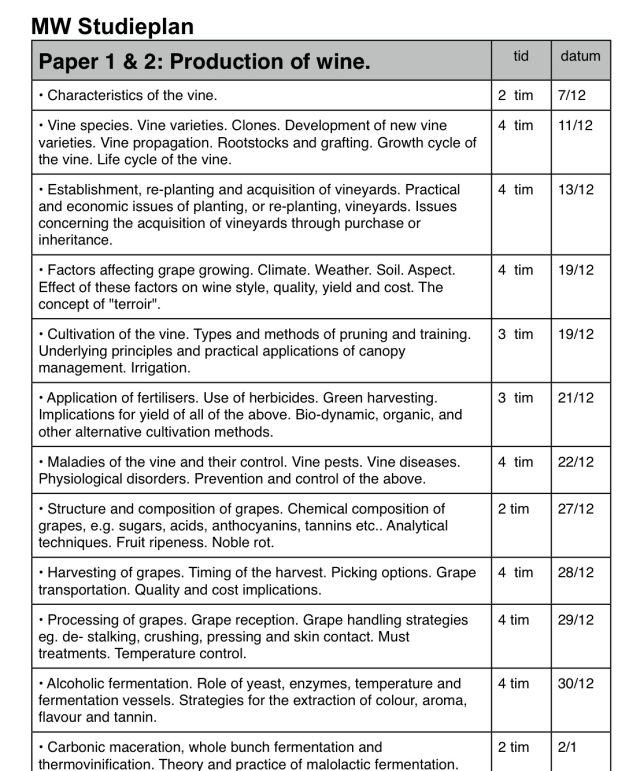
Nästa söndag åker jag till Rust i Österrike för en veckas internat som en del av mina MW-studier. Det känns inte så lite nervöst eftersom en stor del av utbildningen handlar om att identifiera sina svagheter och att hänsynslöst bli bedömd och kritiserad. Jag förväntar mig ett tufft boot camp efter att ha studerat det späckade schemat. Det blir givetvis också lärorikt och intressant med mycket provningar, studiebesök i österrikiska vingårdar och möten med spännande människor.
Eftersom resan mot de två bokstäverna innebär att blotta sig själv, ta kritik och lära sig av det så tänkte jag att det är lika bra att börja här och nu. Här nedanför lägger jag därför ut min ”MW Theory Assignment” som var en del av min ansökan till utbildningsprogrammet. Ämnet för uppsatsen var ”The Next Big Thing in Wine”, en väldigt öppen rubrik som skulle ge möjlighet att visa att man kan argumentera kring en åsikt på ett strukturerat sätt och ge exempel. Det finns inget rätt svar på en sådan uppgift så det var bara att hitta på något.
Varsågoda! Här följer Öhmans spådom om framtiden för vinindustrin på knappt 900 ord. 😉
The Next Big Thing in Wine
During the four last decades we have seen two major forces or trends leading the wine business in the commercial segment; varietal wines and branded wines.
The emerge of varietal wines in the 1970s helped consumers new to wine to identify what styles of wine they liked in a world full of confusing appellations, unknown origins and new wine countries. The growth of branded wines further helped the winelovers to find reliable sources of quality to a reasonable price of these varietals wines under an easily identified name on the supermarket shelves.
Many brands, like Lindeman’s and Blue Nun, has now developed into multi-country-brands, and are delivering increasingly streamlined products behind the familiar labels. With all the different brands, small to multinational giants, the concepts, as the wines and the varietal character, has become increasingly diluted, anonymous, distanced and separated from the consumer.
With the increase of consumtion of better wines many wine consumers today are becoming more educated and demanding and wants to look further than the simple variety. This also reflects in a move towards more awareness of the consumer regarding the quality and origin of food and beverages. Still very important on the market simple brands and varietals doesn’t succeed to fulfill the new and more complex needs and demands of the consumer.
Modern consumers are becoming increasingly aware of the quality of food as seen in the rising numbers of organic products, the popularity of ”farmers markets” and demand for products without unnecessary additives. The marginal trend for ”natural wines” is another side of the same coin; the need to know the content, the origin and the people behind the things you eat and drink.
In other departments of the supermarkets we can see a development as an answer to this. As an example we can find products from large suppliers of dairy and poultry where the individual farmers are identified on the products with labels stating name and address of the farmer and sometimes even with a photo. Bigger coffee brands also diversify their range to include coffee from specific and named plantations. To have a face and a name of the person that produced your breakfast egg or to know where your morning coffee comes from feels safe and secure in a time when you don’t know what is put in the food. For most people the personal connection is more important than any offical seal of quality or brand. The simple rule applies that people trust people (in most cases anyway).
With this development the traceability, identity and personality of the wine will become more important than brand or grape. Four questions should be answered; Who made the wine. Where precisely is it grown. Why is it made. What is, or is not, added.
Some may argue that most of these questions are covered by local wine regulations. But simply to rely on traditional appellations is no solution as most of them can be regarded as mere generic wines (ex AC Bordeaux), or even a kind of brand, and the understanding of the concept is still difficult to grasp for most consumers. The system of appellations is also under revision in many parts of Europe which adds to the confusion.
The solution will be to identify wines by it’s specific plot, location and the people behind it. The specifics of the vineyard and the passion and care of the family/people will be primary, the appellation secondary.
With modern technology it is possible to come closer to the consumer. Even small family estates can communicate directly from the label with the aid of modern and readily available technology such as smart phones with EAN-scanners, GPS locating the exact position of the estate and aiding the consumer finding extensive and updated information of the wine, the family, the place and history. We will also see the grouping of small producers on the internet presenting themselves and their stories. ”Australian Plus” is a good example of this that soon will have more followers. Add to this a web shop and we have a ”virtual wine farmers market”.
Even the big brands and cooperatives will benefit from this development. They will diversify their ranges of wines by identifying batches or sub-brands by plot or grower behind the wine. With the abscence of a definable origin (ex generic, branded Chilean Cabernet Sauvignon) the wine could be identified by a short bio, picture and statement of the winemaker. Big brands can offer the possibility of entering batchnumbers on the website providing detailed information of harvest, vinification and bottling. This transparancy gives traceability a new dimension.
In the near future we will se a strong development on ”wines with identity”. This trend will have a great impact on the wine trade as it will be applicable both to individual small producers and the major brands. As it is easy, and important, to combine with the still dominatingt concept of varietals and brands it will be very easy for the consumer to understand and adapt to the idea.
The next Big Thing in the wine industry is: Wines from a Place and with a Face!







 och citronsyra (citric acid). I en omogen druva dominerar äppelsyran helt men minskar successivt beroende på att a) den bryts ned av druvan till energi i form av glukos och b) vinsyra bildas som en biprodukt vid omvandlingen av sucrosen till nya sockerarter. Vinsyran kommer därmed att vara den helt dominerande syran i det färdiga vinet.





 Öhmans Mat & Vin
Senaste kommentarer